
When exploring your options regarding operationally critical voice communications to support your organization’s teams or work groups, there are many factors to consider. Do you embrace the newer LTE Push-To-Talk (PTT) technology, broadband PTT solutions, or adopt a proven Land Mobile Radio (LMR) communication system?
LMR or simple Push-To-Talk two-way radio offer greater reliability and durability, particularly if weather disasters are prevalent in your area. For example, tropical storms and hurricanes are the leading contributors to power outages in Florida. According to NOAA, the state averages 51 to 100 outages per year, ranking Florida at the higher end of the national average. If you are considering adopting an LTE/IoT (cellular-dependent) communication solution as the source of your communication, these results should be a red flag for you, as this technology is dependent upon the area’s cell towers and other infrastructure to transmit and receive signals. When these outages occur, you will be left helpless without the means to communicate with your team until the towers are restored.
With Land Mobile Radio (LMR) or Push-To-Talk Two-Way (PTT) radio voice communication, these private systems operate independently of commercial cellular infrastructure. Mission-critical voice systems, such as LMR, are built with redundancy in mind and to withstand harsh environments. Two-way radio systems typically require fewer repeaters or antennas than cellular networks, making these systems very reliable because they are more resilient to power outages and extreme weather events and can typically operate on backup power for certain periods of time. Even in situations where the two-way radio system’s infrastructure might be compromised over time, the two-way radios can still communicate radio-to-radio in simplex mode.
What about the costs?

Another consideration when assessing whether LTE technology or a two-way radio system is the right choice for you and your organization is the operating costs over time. With most two-way radio systems, you will have the one-time fees associated with the devices and the build-out of the infrastructure to support your coverage area. Although a one-time fee, Radio One / CSE Crosscom will work with its customers based on their operating preferences to extend a CAPEX vs. OPEX communications procurement model.
Optionally, Radio One / CSE Crosscom can also provide customers with an OPEX model with a Managed Service Agreement that provides organizations the opportunity to maintain a fixed operational expenditure and put the responsibility back on Radio One to maintain the system’s annual upgrades and effectively manage its longevity and reliability, while minimizing the Total Cost of Ownership (TCO).
Alternatively, most LTE device providers offer customers a low entry fee based on the number of devices they require, a much more appealing cost of entry than the upfront costs of building a two-way radio system. With most LTE carrier plans, you will incur a monthly subscription cost per device or user. On the surface, the trade-off on the monthly subscription plans with an LTE provider may appear more appealing, but how will these costs compare over time? As is the case with most cellular carriers, their business model is based on loading their system with multiple users. When confronted with extrapolating the monthly service fee per device over a three-year or even a five-year plan, are the savings you anticipate really there?
What is the durability of these products?
In general, hand-held PTT devices and two-way radio technology have evolved significantly over the years, providing customers with a great deal of flexibility to choose a product that will align with their workers’ responsibilities. From lightweight wearable devices to ruggedized portables with high-performance audio quality and battery life, both LTE and LMR technology provide users with multiple options to choose from.
When selecting the right device for your operations, consider the device’s MIL-SPEC ratings, IP ratings, and battery mAh rating.
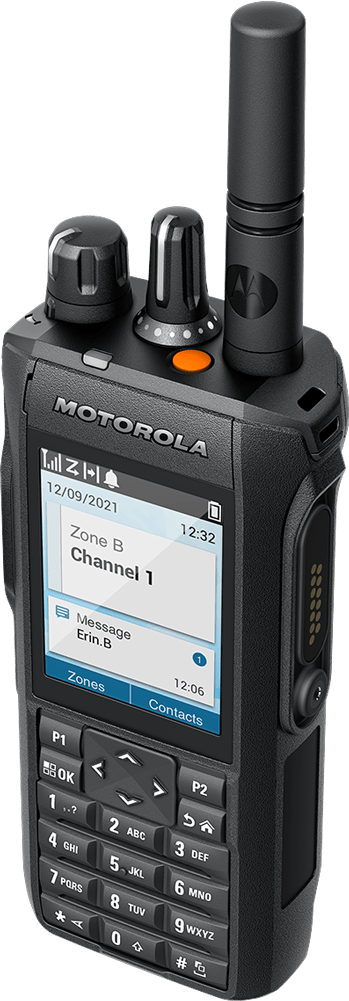
MIL-SPEC stands for military specification and is a set of detailed technical standards developed by the U.S. Department of Defense to ensure products and materials can perform in demanding environments. Products that meet these standards are designed for high durability, reliability, and interoperability, and undergo rigorous testing to guarantee they perform properly under strict military standards.
IP (Ingress Protection) ratings are codes that indicate a device’s level of protection against dust and water. The IP rating consists of two digits: the first indicates protection against solids (from 0 to 6, with 6 being dust-tight), and the second indicates protection against liquids (from 0 to 9, with higher numbers indicating more protection against water). A higher IP rating means better protection.
The other important consideration before selecting the right device is the battery life of your device. To help determine which device will perform better for you, understand the device’s mAh (milliampere-hours) rating. A higher mAh rating typically suggests a longer battery life. The mAh rating is a key metric in measuring how long a device can run on a single charge, which will be affected by usage, screen brightness, device hardware, and software applications. Ratings further include the battery life cycle or the number of charge cycles before the battery capacity begins to degrade.
Before you decide...
Before choosing which devices might be best for your teams or work groups, be sure to consider the product’s MIL-SPEC and IP ratings and the battery’s mAh rating to ensure the technology will hold up in your work environments. Traditionally, LMR technology, such as Motorola Solutions MOTOTRBO radios, has proven to be a more durable and reliable product over time with higher battery performance that stands up in rugged, operationally critical environments for years, which provides enterprises with a better overall TCO.
Are interoperable safety, security, and efficiency solutions a consideration?
With the convergence of technologies, such as video surveillance integration, access control systems, body cameras, and Concealed Weapons Detection (CWD), many of today’s businesses are looking to get more out of their technologies. The opportunity to create more end-to-end solutions that allow what were once disparate technologies to now have interoperability and communicate with one another are important factors for today’s Communications and Information Technology Officers when assessing the acquisition of new technologies.
Through the Motorola Solutions Safety and Security Ecosystem, the opportunity to unify and connect LMR voice technologies with video surveillance and data analytics provides enhanced workflows and improved collaboration for enterprises to protect people, property, and places, and even create direct connections to local public safety agencies to enhance response times.
As an example, MOTOTRBO two-way radios from Motorola Solutions can now receive alerts to radios from video surveillance or access control technology when a door or entry has been breached or security issues are detected. MOTOTRBO dispatch solutions software allows for all two-way radio voice and data transmissions to display real-time activity, send critical notifications, and archive data for forensic and insurance reporting. Likewise, the Motorola Solutions Safety Ecosystem unifies voice, video, and data, so information flows across platforms, operations run smoothly, and collaboration improves. Individually, these technologies make the world safer, but when united, they become exponentially more powerful.
On a more basic level of IoT applications associated with MOTOTRBO radios, these LMR devices are routinely relied upon to send triggers to activate water sprinklers for golf course maintenance crews, open security gates for warehouse distribution centers, or shut down assembly lines when materials need to be replenished or lines experience interruptions.
In addition to the efficiencies that LMR technologies initiate by monitoring, automating, and remotely controlling across many sectors, MOTOTRBO two-way radios can also be connected to corporate workers via the Motorola Solutions WAVE PTX app, Rave Mobile Safety app, or TLK devices. This interconnectivity with LMR systems allows executive workers to stay connected to operations on the factory floor even when they are remote. Managers and supervisors can stay connected with a push of a button to speak with operations or monitor security situations in real time.
These are just a few examples of how interoperability leveraged through two-way radios can help connect your technology to enhance the safety, security, and efficiency of your enterprise.
In today’s fast-paced world there is a great deal of excitement surrounding the evolution of LTE Push-To-Talk communication systems, broadband PTT devices, and next-generation two-way radio alternatives from a variety of new manufacturers. New form factors, attractive pricing models, and alluring product marketing all present enticing alternatives for the traditional LMR/two-way radio users to consider. Before you make any hasty decisions, do your homework and make sure you review the product’s capabilities to keep you connected when you are confronted with a power outage, the true Total Cost of Ownership (TCO) over a three- to five-year model, the ruggedness and durability of the devices, as well as the technology’s capacity to create interoperable safety, security, and automation capabilities.